Sunday, October 16, 2011

The Empty Chamber (Reprise)


I've always been a little ambivalent about the "broken branch" thesis. On the one hand, Thomas Mann and Norman Ornstein make a good case that things have gone downhill in both houses of Congress since the glory days of Lyndon Johnson and Sam Rayburn. George Packer has made the same argument, specifically about the Senate, in The New Yorker. Actually, no one has issued the indictment more eloquently than former Senator John Glenn. Looking back on his long career, he writes:

In my twenty-two years in the Senate, I had watched the legislative process change. There was always partisanship--that was the nature of the system. Although it produced disagreement and debate, it ultimately forged budgets and laws on which reasonable people could differ but that worked for most. In general, lawmakers performed their duties in an atmosphere of mutual respect.

This was no longer the case. By the 1994 election, we had single-issue candidates, the demonization of government, the sneering dismissal of opposing points of view, a willingness to indulge the few at the expense of the many, and the smug rejection of the claims of entire segments of society to any portion of the government's resources. Respectful disagreement had vanished. Poisonous distrust, accusation, and attack had replaced it.

On the other hand, sometimes it seems to me that maybe the good old days weren't all they're cracked up to be--maybe, as a wag once suggested, they never were! Certainly, the vicious caning of Senator Charles Sumner of Massachusetts by South Carolina's Preston Brooks in 1856 (pictured above) hardly qualifies as "respectful disagreement."

On the third hand, you can make the case that what's wrong with Congress is that its powers have been usurped by an all-consuming executive branch whose mandate comes from what James Madison referred to as "the superior force of an interested and overbearing majority." Or you could argue that Congress has simply abdicated while the executive--and the judiciary--have been flexing their muscles. Either way, the explanation for Congressional irresponsibility starts to sound like the old saw about academic politics: it's vicious precisely because "the stakes are so low."

Wednesday, October 12, 2011

Mighty Slovakia Bails Out Europe


Sounds like a headline in The Onion, doesn't it? Well, it's really real. As the Autumn 2011 Glenn Fellows learned last week at the K Street offices of the E.U. delegation to the United States, the European Union, like the Congress under the Articles of Confederation, needs unanimity from its members to do anything of significance. That lesson has been on display this week in Bratislava, capital of the Slovak Republic, where a governing coalition was undone by rejection of the bailout fund, and where, today, a new government appears ready to sign off on the deal.

Wednesday, October 5, 2011

Garfield--a book review


My first full-time teaching job was at Hiram College in northeastern Ohio. When I washed up on the shores of that bucolic campus in the summer of 1970—I was 25 years old—I was vaguely aware that the school was the descendant of something called the Western Reserve Eclectic Institute, and that it had been founded by the Disciples of Christ in 1850. I also was aware that its most famous alumnus was James Abram Garfield, the twentieth president of the United States. Somewhere along the way I had learned that Garfield was assassinated by a "disappointed office seeker" and that he was succeeded by a non-entity named Chester A. Arthur.

That was about it. For me Garfield was merely one of several post-Civil War Ohio Republican presidents who had been officers in the Union Army during the Civil War and wore full beards. I probably could not have picked Garfield out of a lineup if it had included Rutherford B. Hayes and Benjamin Harrison. Over the next decade and a half, I was to learn a lot more, some of it from Allan Peskin’s definitive biography, Garfield (Kent, OH: Kent State University Press, 1978), and some of it from my faculty colleagues, alumni of the college, and local townspeople.

Early on, It was pointed out to me that one of the handsomest houses in Hiram Village, still in use as a private residence, had been Garfield’s home while he served as teacher and principal of the Western Reserve Eclectic Institute. Several alumni of the college were, it was said, on friendly terms with direct descendants. Faculty colleagues supplied some important biographical details. Garfield, I was to learn, was born in a very rude log cabin on the Ohio frontier, endured desperate poverty through much of his childhood, and went to work early on the Erie and Ohio Canal. Garfield’s was a Horatio Alger story—literally, I read the book. He worked his way through the Eclectic as a janitor, proving to be a brilliant and industrious scholar with a gift for friendship and leadership. He wrestled with his students, and he debated itinerant atheists. There were persistent rumors about his having carried on a love affair with Almeda Booth, one of his teachers at the Eclectic. In 1858, he married a local girl, Lucretia Rudolph; their love letters were collected and edited by a colleague in the English department. Another colleague produced a play about Garfield’s assassination.

Garfield was an accomplished scholar in several fields, including Latin and Greek. Though he studied ancient languages, he was enlightened in many ways that we would consider modern. He was a voracious reader; he was one of the few Members of Congress who made good use of his lending privileges at the Library of Congress; he was a confirmed abolitionist before the war and remained committed to full racial equality afterwards. He treated everyone with respect, had a playful sense of humor, and saw both the tragic and comic aspects of the human condition. In an age of rampant political corruption, Garfield was a man of honor, though he was no goody two-shoes.

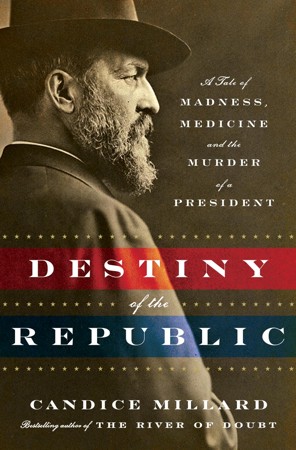
That Garfield was “not just a tragic figure, but an extraordinary man” is one of the major themes of a new book: Candice Millard’s Destiny of the Republic: A Tale of Madness, Medicine, and the Murder of a President. The book is a careful study of the assassination based on extensive research in what appear to be the most relevant sources. The madman at the center of the tale is, of course, the assassin, Charles Guiteau. The practice of medicine was very much in flux at the time, with older physicians in the United States being strongly inclined to resist the revolutionary ideas of England’s Dr. Joseph Lister, who called for antisepsis in the operating room based on his understanding of the role of germs in the spread of disease. As for murder, Millard endorses the testimony that Guiteau provided at his trial: Guiteau might have done the shooting, but Garfield’s attending physicians murdered him with two months of wrong-headed, agonizing treatment. The chief physician, the ironically named Dr. Bliss, introduced infection when he and many others repeatedly stuck their fingers in Garfield’s wound searching for the bullet. Later, they were unable to recognize the infection that had set in, let alone stop its spread. Millard is unable to resist the temptation to assert that this was a case in which ignorance, literally, was Bliss. The other major character in this sad tale is Alexander Graham Bell, who invented a metal detector called the Induction Balance that he hoped would aid Garfield’s physicians in their search for the bullet. Unfortunately, the perfection of the device came too late to save the intended beneficiary.

This is a wonderful book, though in a recent Washington Post review, Del Quentin Wilber makes a legitimate point when he complains that the story of Bell’s Induction Balance is somewhat tangential to the Garfield drama. I am inclined to concede the point, but for me it doesn’t begin to ruin what is an informative and moving story. I do, however, have two reservations of my own.

The first has to do with Guiteau and his motives. Invariably, Guiteau is described as a “disappointed office speaker,” and Millard shows that he lobbied shamelessly to be appointed to a consulship to Paris. There can be no question about his having been a disappointed office seeker. But, as Millard makes clear, he was also a lunatic, a religious fanatic who was convinced that his deed had been divinely inspired. It suited the enemies of the spoils system and the advocates of civil service reform to play down his derangement while stressing the role that the patronage system played in causing a disappointment keen enough to inspire assassination.

The second has to do with the book’s title, which asserts that the destiny of the republic was at stake during the many weeks that Garfield’s physicians attended so incompetently to their patient. This is a little overwrought. For one thing, it doesn't consider the extent to which the powers of the presidency were circumscribed in the late 19th century, despite Lincoln’s aggrandizement of the office during the Civil War. And in any case it isn't clear what public policies were at stake as the honest and enlightened Garfield lay on his deathbed and the hapless Chet Arthur, the creature of a political machine, cowered in a Manhattan townhouse. Garfield may have been the one politician of the Gilded Age who had it in him to put an end to the spoils system, introduce the principle of merit into public service, and put a hammerlock on Jim Crow—had he not been thwarted by an assassin’s bullet. But, as it happened—and Millard tells this story very well indeed—mediocre Chet rose to the occasion to an extent that no one had imagined possible, which is further cause for wondering whether Guiteau's heinous deed altered the course of American political history.

If it seemed to some people at the time that the destiny of the republic truly was at stake, it may be because the president of the United States, in addition to be chief legislator, chief diplomat, and leader of his party, serves as head of state—part of what Walter Bagehot called the “dignified” aspect of government, in contradistinction to the “efficient” exercise of political power. The American people will mourn a president—even one who is practically unknown to them, like William Henry Harrison, or one who was unloved because he was unlovable, like William McKinley—because the president is, among other things, the embodiment of the state. In Garfield’s case, the mourning was profound, because his many virtues, which included his gregarious and passionate nature, were so conspicuous. He must have been an easy man to love. Careful readers of Millard’s admirable book will mourn his loss still.

Monday, October 3, 2011

Great Moments in Debt Crisis Management (reprise)


Ordinarily the Washington Buckeye prefers linking, rather than simply reproducing, sources that shed light on what used to be called "problems of democracy." Today (July 24, 2011), however, the Outlook section (page B5) of the Washington Post contains a piece by historian Chris Myers Asch that speaks so directly to the continuing crisis over raising the debt ceiling--while demonstrating the enduring dangers of unintended consequences--that the copy-and-paste temptation has proven irresistible, especially since the autumn 2011 class of John Glenn Fellows is reading the Simpson-Bowles report, "Moment of Truth," this week. Here is Ashe's essay.
President Obama and congressional Republicans are still struggling to strike a deal on the debt ceiling that would keep the nation from default. It is difficult to foresee what final compromise they might reach — but it’s hard to imagine one more consequential than the bargain struck more than 200 years ago that ended another debt crisis while laying the foundation for our economic system. That fateful deal also ensured that Washington became a slave capital.

In 1790, the federal government and the states were nearly $80 million in the red, burdened by annual interest payments that were triple the nation’s income. A decade after the financially strapped United States madly raised funds for the Revolutionary War, the country was facing default. If the new nation failed to pay its debts, Treasury Secretary Alexander Hamilton feared, it would be shut out of world markets. Foreign governments and individual investors, worried that their loans would never be paid back, might refuse to invest in America. The young economy would be crippled.

To avoid economic collapse, Hamilton proposed a series of financial reforms, including “assumption,” or having the federal government assume the states’ debts and commit to paying their full value. A national debt, he argued, was “the price of liberty” — a free nation was not free to walk away from its financial obligations. Many members of Congress, particularly Virginia’s James Madison and other Southerners, vociferously objected. Opponents saw assumption as a sign of the growing power of the federal government and rejected Hamilton’s insistence that the Constitution’s “necessary and proper” clause allowed fiscal measures of such huge scope.

The issue produced what Secretary of State Thomas Jefferson called “the most bitter & angry contests ever known in Congress.” Opponents of assumption threatened secession, and they had enough votes to block the measure. Hamilton, a New Yorker, knew that Jefferson had substantial credibility with Madison and the Southerners, and he pleaded for help. Jefferson agreed to intervene, hatching a compromise that also addressed the other major political stalemate that bedeviled Congress that spring: where to put the nation’s capital.

The Constitution authorized Congress to create a federal district to serve as the national seat of government but did not specify its location. The city awarded this prize would enjoy prestige, power and economic growth. If built in the South, the capital would also be more likely to protect the bedrock of the Southern economy: slavery.

In 1790, about 20 percent of Americans were considered property. Though some Southern leaders felt uneasy about the institution — Jefferson, a slave-owner, fretted about its “unhappy influence” — few could imagine the South without slaves. As an international abolitionist movement gained steam in the late 18th century, many Southerners felt under siege and believed that a Southern capital would protect their interests. But they did not have the votes to put the capital in the South, while Hamilton, a founding member of the New-York Society for Promoting the Manumission of Slaves, did not have the votes to get his assumption plan through Congress.

Jefferson, hardly a disinterested observer, stepped in to broker a compromise. Over dinner at his rented Manhattan home in mid-June — historian Joseph Ellis called it “the most meaningful dinner party in American history” — Jefferson brought Hamilton and Madison together to hammer out an agreement. Madison agreed to lean on Southern representatives to support the assumption bill. In exchange, Hamilton would persuade his Northern allies to support a capital on the banks of the Potomac.

It was a deal with tremendous long-term consequences for the nation and for the future capital. The compromise secured America’s financial future as well as the constitutional doctrine of implied powers, strengthening the federal government at a critical time.

But the deal sealed the new city’s fate as a slave capital. Safely ensconced between two of the country’s largest slave states, Washington became a glaring contradiction — a citadel of freedom that nonetheless protected slavery and prospered from the burgeoning domestic slave trade. Thanks to the port of Alexandria, which remained part of the District until 1846, D.C. became the largest slave-trading city in the nation. Slaves here were an everyday part of life. They helped build the city, they lived in the White House, and they were sold on auction blocks downtown.

Fighting a war to preserve the Union from a slavery-friendly capital, President Abraham Lincoln tread cautiously lest he frighten Maryland into the arms of the Confederacy, resisting calls for D.C. emancipation until 1862 and allowing compensation to be paid to Washington slave-owners. For almost a century after the Civil War, D.C. remained distinctly Southern, with separate schools, neighborhoods and jobs for its black citizens. The city’s white leadership repeatedly rebuffed attempts to create an interracial democracy. Instead of representative self-government, D.C. was ruled by three invariably white commissioners appointed by the president, an arrangement that one commissioner in 1901 called “an ideal form of government because it is a government by the best citizens.”

Today, with the District losing its black majority, battles over gentrification, voting rights, school reform and even bike lanes show that racial tension remains embedded in Washington life. The grand bargain struck over Jefferson’s dinner table in 1790 came with a tremendous price.

October 2, 2011 update: Simpson and Bowles weigh in with advice to the debt supercommittee in the Post today.

Tuesday, September 20, 2011

Solar Decathlon 2011


Because the National Book Festival has top billing this weekend, the Solar Decathlon has been relegated to West Potomac Park, which is just off the Mall, near the Franklin Delano Roosevelt Memorial and not far from the new Martin Luther King, Jr., National Memorial.

The Solar Decathlon is sponsored by the U.S. Department of Energy. Twenty teams are competing in the 2011 event, which will open on Saturday, September 23, and run through Sunday, October 2. The team from The Ohio State University will try to improve on its top ten performance of 2009. Because of the plethora of interesting things to do on or near the Mall this weekend, Glenn Fellows could easily scratch a half-dozen activities off their checklists for the quarter. And then they can write about their experiences on the WAIP blog.

Sunday, September 18, 2011

National Book Festival


The Fall 2011 class of John Glenn Fellows moved into the Congressional apartment building today, which means that the National Book Festival can't be far behind. Sponsored by the Library of Congress and now in its eleventh year, the event will take place on the National Mall next weekend, September 24-25.

One of the big attractions of the National Book Festival is the opportunity it provides to meet best-selling authors. Here is a list of featured authors.

September 19 update: See photo above of the Fall 2011 class on the stairs at the National Archives. From left to right: Zachary Druga, Alexandra Constantinou, Joseph Guenther, Gianna Domine, Blake Swineford, Abby Warner, Karlton Laster, Mitchell Moximchalk, Anthony Adornetto, Kyle Nappi. Check out their brief bios here.

Monday, September 5, 2011

Remembrance and Reflection


For the tenth anniversary of the terrorist attacks of September 11, 2001, the National Museum of American History has assembled an exhibition of more than 50 objects recovered from wreckage at the World Trade Center, the Pentagon, and Shanksville, Pennsylvania. These objects, which under any other circumstances would be regarded as entirely prosaic, help to convey the human dimensions of the tragedy of that day. For one week, the objects will be displayed on open tables at the Museum, which is on the Mall at Constitution Avenue and 14th Street, N.W. Dana Milbank has a piece about the exhibit in Sunday's Washington Post. In the same issue, Marc Fisher writes about the how the Pentagon attack has been completely overshadowed not only by the images of Ground Zero but even by the extended memorialization controversy. Meanwhile, Anne Applebaum considers the appalling cost of the War on Terror pursued in response to the attacks. It is my understanding that after this week the artifacts will become part of the permanent collection of the Museum, which means that the incoming class of Autumn 2011 Glenn Fellows will be able to see them under glass.

September 7 correction: I went to see the show today. It's very moving, in part because the items are spread out on tables quite informally, along with minimalist identifying labels, like the objects for sale at a church bazaar. When the show closes on September 11, they will be sent for permanent storage to New York. So it's now or never for Washingtonians.