Sunday, October 7, 2012

The Brief against Brandeis (reprise)


There is no denying that the long-lived Louis D. Brandeis (1856-1941) was an American treasure. The son of Eastern European Jewish immigrants, he graduated at age 20 with the highest GPA in the history of Harvard Law School. He made his reputation as a Progressive lawyer and as a leader of the worldwide Zionist movement. In 1916, he was nominated for a seat on the United States Supreme Court by President Woodrow Wilson.

The definitive biography of Justice Brandeis was published by Pantheon in 2009. The work of Melvin I. Urofsky of Virginia Commonwealth University, the 955-page tome has received rave reviews. One, written by Anthony Lewis, appeared in The New York Review of Books. Brandeis, according to Lewis,


was intensely interested in facts. His law clerks did research on facts as much as law. When the Court considered a case on presidential appointment power that involved the 1867 Tenure of Office Act, Brandeis had his law clerk, James M. Landis (who became the dean of Harvard Law School), go over the Senate journals of 1867 to see what the views of the times were. Landis spent months in the Library of Congress reading the journals page by page.

Brandeis even tried to get Justice Holmes, who read philosophy in the original Greek, to take more interest in facts. He urged Holmes to spend the summer break reading up on working conditions and visiting the textile mills in Lawrence, Massachusetts. A year later Holmes wrote Harold Laski that “in consideration of my age and moral infirmities, [Brandeis] absolved me from facts for the vacation and allowed me my customary sport with ideas.”

Brandeis’s obsession with facts continues to reverberate through American law and politics. Consider, for example, what Wikipedia has to say about the term “Brandeis brief,” which refers to


a pioneering legal brief that was the first in United States legal history to rely not on pure legal theory, but also on analysis of factual data. It is named after the litigator Louis Brandeis, who collected empirical data from hundreds of sources in the 1908 case Muller v. Oregon. The Brandeis Brief changed the direction of the Supreme Court and of U.S. law. The Brandeis Brief became the model for future Supreme Court presentations in cases affecting the health or welfare of classes of individuals. This model was later successfully used in Brown v. Board of Education to demonstrate the harmful psychological effects of segregated education on African-American children.

This week members of the Autumn 2012 class of Glenn Fellows are reading essays and court cases organized around the theme of fact-finding and its jurisprudential consequences. As they read these materials, my hope is that they will perform a little thought experiment by asking themselves about the facts that the Court recognized in Muller, Brown, and Roe v. Wade, and whether it would have been wiser for the Court to base its rulings on strictly legal grounds, rather than conducting fact-finding expeditions.

In Brown, for example, the Supreme Court had the option of resurrecting Justice Harlan’s stirring dissent in Plessy v. Ferguson, which would have meant striking down school segregation on the grounds that “our constitution is color-blind,” rather than on the less substantial grounds that segregated schools inflict psychological damage upon African-American children. Likewise, in Roe v. Wade, there were a number of precedents that the Court, rather than wrestling with the question of fetal viability and formulating a national “right of privacy,” might have used to finesse the issue of abortion by declaring that public health is a matter that the Constitution, through the Tenth Amendment, reserves to the states. I hope the Fellows will ask themselves, in short, whether the Brandeis brief, so well intentioned, has been responsible for a great deal of legal and political mischief in the century since Muller v. Oregon.

October 8, 2012 update: It turns out that this could be a big week for affirmative action. Oral arguments are scheduled for Wednesday in Fisher v. University of Texas, a case filed by a white woman who claims to have been a victim of racial discrimination when she was rejected for admission to the university. According to Robert Barnes in the Washington Post, the case has elicited 92 amicus curiae briefs. It also has inspired an op-ed piece in Sunday's Post co-authored by the law school deans at both Harvard and Yale. Ready to hear the case against affirmative action? Tomorrow is the publication date for a book by Richard Sander and Stuart Taylor, Jr., called Mismatch, which is attracting rave reviews mainly, but not exclusively, from the right.

Thursday, October 4, 2012

Garfield: A Book Review (Reprise)


My first full-time teaching job was at Hiram College in northeastern Ohio. When I washed up on the shores of that bucolic campus in the summer of 1970—I was 25 years old—I was vaguely aware that the school was the descendant of something called the Western Reserve Eclectic Institute, and that it had been founded by the Disciples of Christ in 1850. I also was aware that its most famous alumnus was James Abram Garfield, the twentieth president of the United States. Somewhere along the way I had learned that Garfield was assassinated by a "disappointed office seeker" and that he was succeeded by a non-entity named Chester A. Arthur.

That was about it. For me Garfield was merely one of several post-Civil War Ohio Republican presidents who had been officers in the Union Army during the Civil War and wore full beards. I probably could not have picked Garfield out of a lineup if it had included Rutherford B. Hayes and Benjamin Harrison. Over the next decade and a half, I was to learn a lot more, some of it from Allan Peskin’s definitive biography, Garfield (Kent, OH: Kent State University Press, 1978), and some of it from my faculty colleagues, alumni of the college, and local townspeople.

Early on, It was pointed out to me that one of the handsomest houses in Hiram Village, still in use as a private residence, had been Garfield’s home while he served as teacher and principal of the Western Reserve Eclectic Institute. Several alumni of the college were, it was said, on friendly terms with direct descendants. Faculty colleagues supplied some important biographical details. Garfield, I was to learn, was born in a very rude log cabin on the Ohio frontier, endured desperate poverty through much of his childhood, and went to work early on the Erie and Ohio Canal. Garfield’s was a Horatio Alger story—literally, I read the book. He worked his way through the Eclectic as a janitor, proving to be a brilliant and industrious scholar with a gift for friendship and leadership. He wrestled with his students, and he debated itinerant atheists. There were persistent rumors about his having carried on a love affair with Almeda Booth, one of his teachers at the Eclectic. In 1858, he married a local girl, Lucretia Rudolph; their love letters were collected and edited by a colleague in the English department. Another colleague produced a play about Garfield’s assassination.

Garfield was an accomplished scholar in several fields, including Latin and Greek. Though he studied ancient languages, he was enlightened in many ways that we would consider modern. He was a voracious reader; he was one of the few Members of Congress who made good use of his lending privileges at the Library of Congress; he was a confirmed abolitionist before the war and remained committed to full racial equality afterwards. He treated everyone with respect, had a playful sense of humor, and saw both the tragic and comic aspects of the human condition. In an age of rampant political corruption, Garfield was a man of honor, though he was no goody two-shoes.

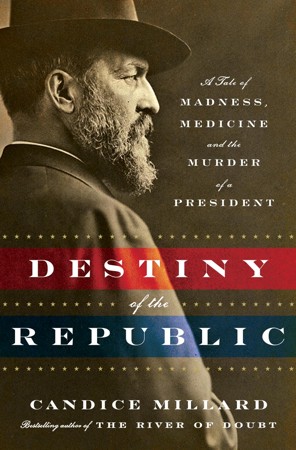
That Garfield was “not just a tragic figure, but an extraordinary man” is one of the major themes of a new book: Candice Millard’s Destiny of the Republic: A Tale of Madness, Medicine, and the Murder of a President. The book is a careful study of the assassination based on extensive research in what appear to be the most relevant sources. The madman at the center of the tale is, of course, the assassin, Charles Guiteau. The practice of medicine was very much in flux at the time, with older physicians in the United States being strongly inclined to resist the revolutionary ideas of England’s Dr. Joseph Lister, who called for antisepsis in the operating room based on his understanding of the role of germs in the spread of disease. As for murder, Millard endorses the testimony that Guiteau provided at his trial: Guiteau might have done the shooting, but Garfield’s attending physicians murdered him with two months of wrong-headed, agonizing treatment. The chief physician, the ironically named Dr. Bliss, introduced infection when he and many others repeatedly stuck their fingers in Garfield’s wound searching for the bullet. Later, they were unable to recognize the infection that had set in, let alone stop its spread. Millard is unable to resist the temptation to assert that this was a case in which ignorance, literally, was Bliss. The other major character in this sad tale is Alexander Graham Bell, who invented a metal detector called the Induction Balance that he hoped would aid Garfield’s physicians in their search for the bullet. Unfortunately, the perfection of the device came too late to save the intended beneficiary.

This is a wonderful book, though in a recent Washington Post review, Del Quentin Wilber makes a legitimate point when he complains that the story of Bell’s Induction Balance is somewhat tangential to the Garfield drama. I am inclined to concede the point, but for me it doesn’t begin to ruin what is an informative and moving story. I do, however, have two reservations of my own.

The first has to do with Guiteau and his motives. Invariably, Guiteau is described as a “disappointed office speaker,” and Millard shows that he lobbied shamelessly to be appointed to a consulship to Paris. There can be no question about his having been a disappointed office seeker. But, as Millard makes clear, he was also a lunatic, a religious fanatic who was convinced that his deed had been divinely inspired. It suited the enemies of the spoils system and the advocates of civil service reform to play down his derangement while stressing the role that the patronage system played in causing a disappointment keen enough to inspire assassination.

The second has to do with the book’s title, which asserts that the destiny of the republic was at stake during the many weeks that Garfield’s physicians attended so incompetently to their patient. This is a little overwrought. For one thing, it doesn't consider the extent to which the powers of the presidency were circumscribed in the late 19th century, despite Lincoln’s aggrandizement of the office during the Civil War. And in any case it isn't clear what public policies were at stake as the honest and enlightened Garfield lay on his deathbed and the hapless Chet Arthur, the creature of a political machine, cowered in a Manhattan townhouse. Garfield may have been the one politician of the Gilded Age who had it in him to put an end to the spoils system, introduce the principle of merit into public service, and put a hammerlock on Jim Crow—had he not been thwarted by an assassin’s bullet. But, as it happened—and Millard tells this story very well indeed—mediocre Chet rose to the occasion to an extent that no one had imagined possible, which is further cause for wondering whether Guiteau's heinous deed altered the course of American political history.

If it seemed to some people at the time that the destiny of the republic truly was at stake, it may be because the president of the United States, in addition to being chief legislator, chief diplomat, and leader of his party, serves as head of state—part of what Walter Bagehot called the “dignified” aspect of government, in contradistinction to the “efficient” exercise of political power. The American people will mourn a president—even one who is practically unknown to them, like William Henry Harrison, or one who was unloved because he was unlovable, like William McKinley—because the president is, among other things, the embodiment of the state. In Garfield’s case, the mourning was profound, because his many virtues, which included his gregarious and passionate nature, were so conspicuous. He must have been an easy man to love. Careful readers of Millard’s admirable book will mourn his loss still.

Monday, September 24, 2012

The Empty Chambers (reprise)


I've always been a little ambivalent about the "broken branch" thesis. On the one hand, Thomas Mann and Norman Ornstein make a good case that things have gone downhill in both houses of Congress since the glory days of Lyndon Johnson and Sam Rayburn. George Packer has made the same argument, specifically about the Senate, in The New Yorker. Actually, no one has issued the indictment more eloquently than former Senator John Glenn. Looking back on his long career, he writes:

In my twenty-two years in the Senate, I had watched the legislative process change. There was always partisanship--that was the nature of the system. Although it produced disagreement and debate, it ultimately forged budgets and laws on which reasonable people could differ but that worked for most. In general, lawmakers performed their duties in an atmosphere of mutual respect.

This was no longer the case. By the 1994 election, we had single-issue candidates, the demonization of government, the sneering dismissal of opposing points of view, a willingness to indulge the few at the expense of the many, and the smug rejection of the claims of entire segments of society to any portion of the government's resources. Respectful disagreement had vanished. Poisonous distrust, accusation, and attack had replaced it.

On the other hand, sometimes it seems to me that maybe the good old days weren't all they're cracked up to be--maybe, as a wag once suggested, the good old days aren't what they used to be--and never were! Certainly, the vicious caning of Senator Charles Sumner of Massachusetts by South Carolina's Preston Brooks in 1856 (pictured above) hardly qualifies as "respectful disagreement."

On the third hand, you can make the case that what's wrong with Congress is that its powers have been usurped by an all-consuming executive branch whose mandate comes from what James Madison referred to as "the superior force of an interested and overbearing majority." Or you could argue that Congress has simply abdicated while the executive--and the judiciary--have been flexing their muscles. Either way, the explanation for Congressional irresponsibility starts to sound like the old saw about academic politics: it's vicious precisely because "the stakes are so low."

January 25, 2012 update: There's an interesting story in today's Politico on the GOP legislative agenda--interesting in part because it features Rep. Steve Stivers.

September 24, 2012 update: Two books about Congress, one of them Mann and Ornstein's It's Even Worse Than It Looks, are reviewed by Ezra Klein in a recent issue of The New York Review of Books. It's premium content, so here's hoping this link will work.

Saturday, September 22, 2012

National Book Festival 2012

It's now officially fall, which means it's time to check out the Library of Congress's National Book Festival on the Mall. Here's a list of featured authors.

Saturday, September 15, 2012

The Skaters

The Autumn 2012 class of Glenn Fellows at the National Gallery of Art, in front of Gilbert Stuart's portrait of Sir William Grant on ice skates. From left to right: Joe Sadek, Program Coordinator; Jade Holmes, Maggie Murdock; Erin Moeller; Ken Kolson, Director; Paige MacMorland; Marissa Cooper; Katie Colburn; Grace Fry; Adam Kase; Maddie Fireman; Amber Seira; Leah Apothaker; Isaac Choi.

Wednesday, September 5, 2012

Why Is There No Socialism in America? (reprise in honor of the Democratic National Convention)


In a lecture reprinted by The New York Review of Books, the late Tony Judt of New York University tells us that this query—why is there no socialism in America?—was posed a century ago by a German sociologist, Werner Sombart. The question remains pertinent, for reasons that I try to explain below, despite the enactment of a great deal of “social democratic” legislation in the course of the twentieth century.

Judt’s lecture explores some of the many answers that have been formulated in response to Sombart’s question. I was surprised, however, that Judt never mentions Louis Hartz (1916-1986), a political philosopher with an original take on American political history that he published during the McCarthy Era as The Liberal Tradition in America (New York: Harcourt, 1955).

Somewhat surprisingly, Hartz’s answer boils down to this: there can be no genuine socialism in America because there was never any genuine conservatism here. And we have no conservatives because in the New World there was no Old Order to conserve. Early settlers came to the British colonies in North America in an effort to get away from vestiges of feudalism (primogeniture and the divine right of kings, for example) that retained their oppressive potency in Europe. We Americans are the descendants of religious dissenters and others who voted with their feet against the Old Order. The deal was sealed when our few remaining Tories, aristocrats, and monarchists escaped, or were chased, to Canada after the American Revolution.

Canada, in fact, proves Hartz’s point. Even today there are a few honest-to-God Tories, and roughly the same number of authentic socialists in Canada, and neither feels obliged to offer apologies for itself. The result, to take just one example, is that the Canadians were able to create something akin to socialized medicine; it couldn’t be rejected, as it has been in the U.S., as part of a wholly alien tradition.

In the United States, by contrast, liberalism (think John Locke, for whom society is atomistic, i.e., the sum of its individual parts) is the only tradition we have. Some American liberals may be inclined to promote equality, even at the expense of personal liberty; Hartz calls them “liberal democrats.” Others may favor liberty over equality; Hartz calls them “liberal whigs.” We have neither a Far Right reminiscing about an organic, corporate order dominated by a benign and paternalistic gentry, nor a Far Left intent on overthrowing bourgeois capitalism and replacing it with a collectivist Social Welfare state (i.e., a Workers’ Paradise). The good news is that there is nothing in our tradition for fascism to feed on. Never mind all the dire warnings over the years about indigenous fascism that have been issued by the Far Left; the closest we’ve ever come was Father Coughlin in the 1930s, and that wasn’t very close. BTW, that's Ben Shahn's image of Father Coughlin and his Hitlerian fist pump up top.

The result, according to Hartz, is that American politics oscillates between the two “extremes” of liberal democracy and liberal whiggery, which aren’t extreme at all, but variations on the same theme. Thus, it is very much in the Hartzian tradition for Judt to pose the following musical question about American politics: “Why is it that here in the United States we have such difficulty even imagining a different sort of society from the one whose dysfunctions and inequalities trouble us so?” It’s because our liberal tradition is so capacious it makes everything else seem beyond the pale.

In the United States, the liberal democrats (i.e., people like Judt) have traditionally had the upper hand. This is because they (unlike, say, the author of Federalist No. 10) have no real reservations about majority rule, and they know how to appeal to majoritarian instincts, some of which are not very honorable (e.g., the abolition of debts). Liberal whigs (e.g., today’s Republicans) have a harder time of it, because if they articulate their principles clearly they run the risk of offending the many who stand to profit from majority tyranny. Still, the liberal whigs are able to compete by planting seeds of fear and doubt in the American democrat. Conjuring up the rags to riches fantasy (e.g., Andrew Carnegie’s “gospel of wealth”) allows the American right, such as it is, to enjoy what Hartz called the Great Law of Whig Compensation, by which he meant that for the death of Hamilton (and genuine Toryism) they are rewarded with the perpetual triumph of McKinley (an Ohioan, of course). You take what you can get. Come to think of it, Hartz himself was born in Youngstown, the son of Russian Jewish immigrants.

Still with me? Hang on, there’s just a bit more. Implicit in Hartz’s description of a consensual and monotonous liberal order is the idea that the parameters of American political discourse are unusually narrow. Tony Judt is on exactly the same page when he says, apologizing for the academic jargon, that the great shortcoming of American politics is discursive. One of the effects of that is that the stakes of American politics are fairly low, though politicians do everything they can to try to make them seem much higher, especially during an election year.

Some will note that the U.S. has had its collectivist moments: the Progressive movement at the turn of the twentieth century; the New Deal during the Great Depression; Lyndon Johnson’s Great Society. And that is true, though each was more of an improvisation than part of a Grand Design, which explains why American institutions differ so markedly from their European counterparts. During our spasms of Social Democracy (to use Judt’s term) in the 1900s, the ‘30s, and the ‘60s, we were trying to solve practical problems; we harbored no wish to create a Brave New World. From the days of Benjamin Franklin at least Americans have been practical-minded empiricists (the Branch method, rather than the Root), not theoreticians.

What Judt has to say at the very end of his lecture is extremely interesting. He is clearly disgusted with the American left for not recognizing that it “has something to conserve,” i.e., the collectivist, social democratic heritage of the twentieth century. He notes that the left often seems intent on apologizing for its own legacy. Judt also criticizes the left for not recognizing that the right (thanks largely to George W. Bush, though he doesn’t say that in so many words) has put itself in the awkward position of advocating utopian ideas such as not worrying about budget deficits (“Deficits don’t matter,” according to Dick Cheney) and making the world safe for democracy. The right, according to Judt, “has inherited the ambitious modernist urge to destroy and innovate in the name of a universal project.” They ought to feel more uncomfortable in that position than they seem to be.

This, in my view, is astounding, especially when one considers that (quoting Judt again, but now with a bow in the direction of Charles Lindblom) “If we learned nothing else from the twentieth century, we should at least have grasped that the more perfect the answer, the more terrifying its consequences.” (Consider, for example, Hitler’s answer to “the Jewish question,” or Stalin’s answer to the challenge posed by the kulaks--that is, prosperous peasants--whose very existence as a class was an affront to Marxist ideology.) Yes, what we have here is another argument for muddling through.

Saturday, September 1, 2012

Autumn 2012 Glenn Fellows Visit VOA

From left to right: Jade Holmes, Amber Seira, Adam Kase, Marissa Cooper, Maggie Murdock, Erin Moeller, Katie Colburn, Paige MacMorland, Leah Apothaker, Maddie Fireman, Grace Fry, Isaac Choi.